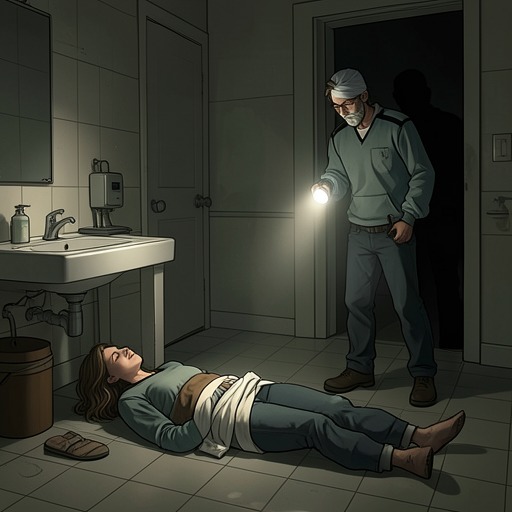
De ontmaskering van Mike Morales als seriemoordenaar
Kay ScarpettaThe exposure of Mike Morales as a serial killer is the investigation’s decisive reversal. What first appears to be a scattered pattern involving Terri Bridges, two unsolved 2003 murders, anonymous electronic identities, and a suspicious medical connection becomes a single system of concealment. Morales is identified as Juan Amate, a man who used professional access, technological surveillance, impersonation, and carefully repeated sexualized violence to control both victims and investigators.
Causes and Background
The first pattern emerges from two possible database matches outside New York. In the summer of 2003, a fourteen-year-old boy from Greenwich, Connecticut, addicted to anabolic steroids, was found naked, bound at the wrists and ankles, and strangled with an object that was never recovered; his body had been dumped near a Bugatti dealership. Two months earlier, a twenty-one-year-old woman who had moved from a small town in North Carolina to Baltimore had been killed after becoming involved in illicit efforts to obtain anabolic steroids. She too was found naked, with her hands bound and her cause of death consistent with strangulation by a missing object. Her body had been left in a harbor dumpster. Neither case produced useful DNA, and the woman had apparently not been raped. The similarities made the cases more than historical curiosities: they supplied a behavioral template for Terri Bridges’s murder.
The recurring marker was a thin, ten-karat gold ankle chain with a herringbone pattern, approximately twenty-five centimeters long and cheap enough to buy at a mall kiosk or online for forty or fifty dollars. The same kind of chain was found on Terri Bridges and later on Eva Peebles, whose body was displayed with her blue eyes open and white hair caught in the noose. The chain appeared to function as a sign of possession or power rather than an incidental piece of jewelry. Unlike the silver rings in another serial case, which suggested that the killer was claiming victims as his own, the ankle chain suggested restraint: the victim was being symbolically converted into property.
The opportunity structure also pointed toward someone familiar with access, routines, and vulnerable spaces. Terri Bridges was alone in her building on New Year’s Eve, while the neighboring resident who might have seen something did not look out at the likely time of death. The police theory held that the killer either possessed a key or was admitted by Terri, who had opened both the exterior door and her apartment door after dark without an intercom or camera to identify the visitor. The holiday provided an empty building and absent witnesses, conditions that made a staged domestic scene easier to construct.
Digital and Professional Clues
Morales’s discovery depends on the convergence of false identities. Terri Bridges used the personal account name “lunasee,” while Oscar Bane used “carbane”; Lucy Farinelli explains that a person may create hundreds of free, nearly untraceable accounts, forming a one-person crowd of aliases. The crucial connection is not merely that identities were hidden, but that the same hidden operator controlled several channels at once. A forged message dated Friday, December 28, 2007, at 23:53:01, appeared to come from Scarpetta and was addressed to Terri Bridges, although Kay Scarpetta insisted that it was not her address and that she had not sent it.
Lucy Farinelli then links Morales to the surveillance apparatus. A motion-sensitive camera had been placed on the roof and automatically emailed every detected movement to a recipient whose computer was soon to be broken into. The IP address and access code associated with Morales matched the credentials used for the scarpetta612 account. The same access code was also connected with the device that sent Terri the mortuary photograph from an Internet café near the practice of Elizabeth Stuart. This made the impersonation of Kay Scarpetta part of a larger operation rather than an isolated act of harassment.
The professional trail leads to a veterinary and medical environment. Elizabeth Stuart describes a large practice with more than sixty employees at four locations and identifies a part-time worker named Juan Amate, who also worked with a veterinary practice and helped care for animals at a pet shop. He had given sick puppies to members of Stuart’s staff, including a hairless-looking Chinese puppy that trembled and coughed. Stuart says that Amate liked giving injections and was trained in drawing blood. His access to needles, veterinary tools, ointments, patients, and staff created a plausible bridge between the earlier Baltimore murder, the Greenwich murder, and Terri’s death.
The Recorded Murder
The breakthrough comes from video files in Mike Morales’s personal email account, whose username was “Forenxxx.” One file records New Year’s Eve not on the roof but inside Terri Bridges’s apartment. The footage shows Terri in the bathroom mirror while gloved hands strangle her from behind with a blue tourniquet of the kind used in hospitals for blood collection. She is naked, her hands are tied behind her back, and she kicks violently at the heart-backed chair as the attacker nearly lifts her from it.
The recording exposes both familiarity and preparation. Terri’s terror is visible in the oval mirror, while the naked man behind her deliberately directs the camera toward his condom-covered penis and presses it between her shoulder blades like a gun barrel. He raises a scalpel before the mirror, and his language suggests that the killing belongs to an established ritual rather than an improvised assault. Terri appears to know him; her familiarity with his manner and the reference to “Juan” support the conclusion that she had encountered him through Stuart’s practice and may have had a sexual relationship with him before becoming involved with Oscar Bane.
The dialogue also reveals the motive’s coercive structure. The killer accuses Terri of having disclosed secrets after she had allowed “the little man” to learn them, complains that he has gone to the district attorney, and tells her that she has caused what is about to happen. He claims to have done her a favor and says that she has betrayed his trust. The scene therefore joins sexual sadism to retaliation and information control: Terri is not only being attacked but punished for allowing knowledge to move beyond Morales’s control.
Recognition and Proof
The video makes the identification overwhelming without making it immediately courtroom-proof. Morales’s face is never visible for even a second, either in the recording of Terri’s murder or in the recording of Bethany’s murder in Baltimore. The same concealment appears in the recording of Rodrick, whose slight young body was later dumped near the Bugatti dealership in Greenwich. The absence of a visible face preserves the gap between recognition and admissible proof: the investigators understand what the recordings mean before they can demonstrate it conclusively.
The repeated method closes that gap circumstantially. In each case, Morales bound the victim’s wrists, wore latex gloves, and used the same lubricant. He had access to Aqualine, a veterinary ointment, and may have stolen an opened container from his work as part of his established method. The ointment may also have helped confuse investigators by mixing or complicating DNA profiles. The identical procedures, the ankle-chain marker, the geographic links, and the professional access transform separate murders into a serial pattern attributable to one offender.
The final recognition is thus layered. Morales is exposed as Juan Amate through the veterinary connection, as the operator behind the camera and false Scarpetta account through shared digital credentials, and as the killer through the video’s repeated choreography and the forensic parallels. His identity is not revealed by a single confession or a clear facial image; it is reconstructed from the systems he believed would keep him hidden.
Consequences and Significance
The exposure changes the meaning of earlier evidence. Oscar Bane’s apparent guilt becomes part of Morales’s design, since Morales used surveillance, impersonation, and staged information to direct suspicion toward him. The camera on the roof, the forged correspondence, the mortuary photograph, and the recorded murder all belong to one strategy: Morales watched others while preventing them from seeing him clearly.
The event also exposes the danger of professional respectability as camouflage. Morales’s work around medical and veterinary practices gave him access to bodies, instruments, substances, and vulnerable people, while his hidden identity as Juan Amate allowed him to move between institutions without presenting a coherent public self. His aliases and technical traces functioned as protective masks, but the very repetition required to maintain those masks produced the evidence that ultimately dismantled them.
For the investigation, the value shift is from suspicion without form to recognition with a complete behavioral architecture. Terri Bridges’s death is no longer an isolated domestic killing, Eva Peebles’s ankle chain is no longer an unexplained detail, and the two 2003 cases are no longer unrelated failures. The discovery reveals a serial killer who turned anonymity, surveillance, medical familiarity, and staged victim narratives into weapons—and whose repeated signatures finally made concealment impossible.